


PREAMBLE
As the ASLTON/NISLT RIVERS 2025: 40th Annual Conference and Scientific Workshop – Charting the Course for Policy, Sustainability, and Productivity in Science Laboratory Practice draws near, the anticipation within Nigeria’s scientific and professional community continues to build.
In this insightful interview, Dr. Henrrietta O. Asuzu-Samuel, FISLT, Chairperson of the Local Organizing Committee (LOC) and Rivers State Chapter of the Association of Science Laboratory Technologists of Nigeria (ASLTON), discusses the strategic direction, key policy imperatives, and expected outcomes of the forthcoming conference. She highlights how the Rivers State Chapter of ASLTON has demonstrated exceptional preparedness and organizational commitment to delivering a landmark event that will redefine standards, strengthen professional capacity, and promote sustainable laboratory practices across the nation.
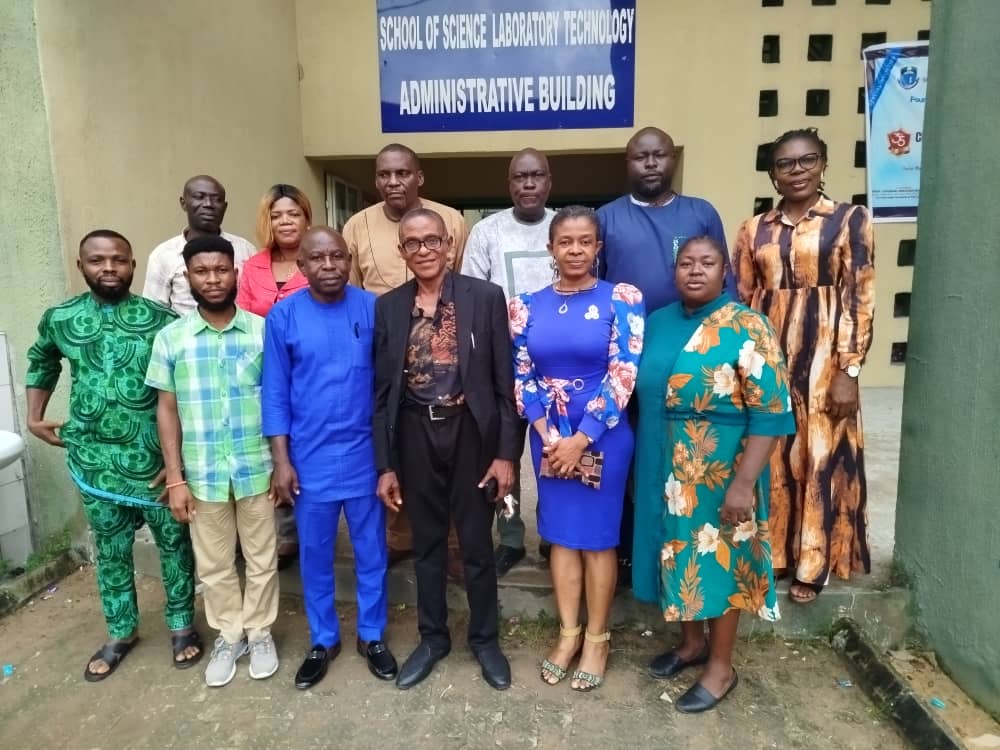
ASLTON National Executive with the Rivers state executive and RIVERS 2025 LOC TEAM on a courtesy visit to Dean SSLT University of PortHarcourt
SCI &TECH CONNECT TEAM: Dr. Henrrietta Asuzu Samuel, could you kindly introduce yourself and share a bit about your role as the Chairperson of the Local Organizing Committee for the 40th Annual Conference and Scientific Workshop?
DR Henrrietta: Good morning everyone, I am Dr. Henrrietta Ogadimma Asuzu-Samuel FISLT a Fellow of the Nigerian Institute of Science Laboratory Technology (NISLT) with my specialty in Physiology/Pharmacology Technique; A Senior Lecturer at School of Science Laboratory Technology, University of Port Harcourt; An Assistant Director of Exchange and Linkage Programmes Unit of Uniport; Chairperson, State Chapter of the Association of Science Laboratory Technology of Nigeria (ASLTON), Rivers State Chapter and the Local Organizing Committee (LOC) of 40th Annual Conference and Scientific Workshop of ASLTON/NISLT Conference Tagged “RIVERS 2025”. On behalf of the entire Local Organizing Committee, it is my genuine privilege and honor to welcome you to the 40th Annual Conference and Scientific Workshop.”
As the Chairperson of the Local Organizing Committee (LOC), I must first express our profound gratitude to the association’s leadership, the sponsoring organizations, and, most importantly, to all of you, our dedicated attendees, for making this milestone event possible.”
“My role, at its core, is to act as the chief conductor for the orchestra that runs this conference. I have the responsibility of overseeing and integrating the work of all our sub-committees – from scientific programming and abstract review to logistics, venue management, and social events “as follows:
* Strategic Direction: Ensuring the conference’s format, theme, and schedule align perfectly with the association’s mission and the expectations for this 40th anniversary celebration.
* Team Leadership: Guiding, motivating, and supporting our diverse team of volunteers and professionals to ensure every detail – from your registration badge to the final session – is executed flawlessly.
* Stakeholder Liaison: Serving as the primary point of contact between the LOC, the National Steering Committee, our sponsors, and the host state/venue.
* Ensuring the Experience: My ultimate goal is to create an environment that is scientifically stimulating, logistically seamless, and personally enriching for every single delegate.”
We have worked tirelessly to craft a program that honors the four decades of scientific progress and looks forward to the next. Our commitment as the LOC is to ensure you can focus entirely on the science, the networking, and the collaboration.”
“If you see me throughout the week, please feel free to stop me and say hello! We are here to serve you and ensure you have a truly productive and memorable experience. Welcome again!”
SCIE &TECH Connect TEAM: . The theme of the upcoming conference, “Efficient Policy Matrix: A Pathway to Sustainability and Productivity of the Science Laboratory Profession,” sounds both timely and important. Can you elaborate on what this theme means and why it was chosen?
DR. Henrrietta : The theme centers on three key components — Efficient Policy Matrix, Sustainability, and Productivity — which together define a modern, forward-looking framework for advancing the science laboratory profession.
A. Efficient Policy Matrix (Strategy & Solution):
This represents a comprehensive system of clear, coherent, and cost-effective policies governing laboratory operations—covering safety, waste disposal, quality control, procurement, accreditation, human resources, and funding. Efficiency means these policies are streamlined, easy to follow, and mutually supportive rather than conflicting.
B. Sustainability (Long-Term Goal):
Sustainability has two aspects:
- Environmental Sustainability (Green Labs): Reducing energy use, water consumption, and hazardous waste.
- Financial/Operational Sustainability: Ensuring long-term viability through stable funding, strong infrastructure, and continuous professional growth.
C. Productivity (Core Output):
Productivity reflects laboratory success through increased output, improved quality, and reduced delays. Efficient policies enhance productivity by preventing accidents, minimizing bureaucracy, and ensuring quality assurance.
The theme addresses key sectoral challenges:
- Cost-Policy Gap: High operational costs from inefficient resource use.
- Safety-Productivity Trade-Off: Showing that strong safety policies actually boost productivity.
- Professionalization Need: Modern policies to attract and retain skilled professionals.
- Global Mandate: Aligning with the UN Sustainable Development Goals through responsible practices.
True productivity and sustainability in the science laboratory profession depend on a well-designed, efficient policy framework. The conference aims to create, discuss, and promote these next-generation policies to secure the profession’s future and global relevance.
Scie &Tech ConnectTeam: One of the sub-themes of the conference focuses on “The Human Cost for Poor Laboratory and Vendor Regulation.” Can you explain the significance of this issue and how it impacts both public safety and the economy in Nigeria?
DR. Henrrietta: The sub-theme, “The Human Cost for Poor Laboratory and Vendor Regulation,” highlights how weak regulatory systems in Nigeria’s laboratory and vendor sectors endanger public safety and hinder economic growth. It connects the scientific and commercial environments, emphasizing that poor regulation leads to both human suffering and national economic loss.
1. Dual Failure of Quality Assurance:
Two major regulatory breakdowns compound the crisis:
- Laboratory Regulation: Inaccurate results from poorly managed labs cause misdiagnoses, faulty research, and unsafe industrial outputs.
- Vendor Regulation: Substandard or counterfeit inputs (chemicals, reagents, and equipment) undermine laboratory accuracy and reliability.
2. Impact on Public Safety and Health:
- Healthcare Risks: Misdiagnoses and fake medical supplies lead to treatment failures, drug resistance, disease spread, and loss of trust in the healthcare system.
- Occupational & Environmental Hazards: Poor enforcement of lab safety standards exposes professionals to toxic materials and accidents, while improper waste disposal pollutes the environment and endangers communities.
3. Impact on the Economy:
- Financial Costs: Treating preventable medical errors and the use of counterfeit products increases healthcare expenses and damages Nigeria’s export credibility due to lack of international certification.
- Loss of Productivity & Capital Flight: Frequent equipment failures, delays, and the need to send samples abroad weaken local industries and drive skilled professionals to leave the country.
The sub-theme calls for strong, efficient regulation of laboratories and vendors as a cost-effective national investment to safeguard public health, strengthen the economy, and retain scientific talent.
Scie &Tech Connect Team: Another sub-theme addresses “Yesterday, Today, and Tomorrow: My Story and Vision in Starting, Running, and Maintaining a Science Laboratory.” What role do you see personal experiences playing in shaping the future of science laboratory practices in Nigeria?
DR. Henrrietta: The sub-theme, “The Role of Personal Experience in Shaping Nigeria’s Laboratory Future,” emphasizes that policies and systems are only as effective as the people implementing them. It highlights how the experiences, insights, and resilience of current leaders can guide and inspire the next generation of laboratory professionals in Nigeria.
1. Bridging the Theory–Practice Gap:
Personal experiences help translate theory into practice by offering real-world solutions to Nigeria’s unique challenges—such as power shortages, foreign exchange barriers, and bureaucratic delays. Leaders’ success stories provide practical, low-cost strategies and demonstrate that achieving international standards (like ISO accreditation) is possible even with limited resources.
2. Building Resilience and Professional Identity:
Sharing personal stories of struggle and success fosters mentorship, motivation, and pride among younger professionals. It helps reduce burnout and brain drain by showing that perseverance leads to impact and recognition. Real-life accounts of critical lab work or safety incidents reinforce professional value and cultivate a strong safety culture.
3. Driving Innovation and Advocacy:
Experiential insights fuel innovation and policy reform. Leaders’ stories supply real data for advocacy, inspire entrepreneurship among young scientists, and shape the vision for the profession’s future—moving toward automation, proactive research, and full compliance with quality systems.
This sub-theme transforms the conference into a collective mentorship platform, turning leaders’ personal experiences into institutional knowledge that accelerates the growth, professionalism, and sustainability of Nigeria’s science laboratory sector.
Scie &Tech Connect Team: The conference will feature various scientific sessions and syndicate groups. Can you share some of the key topics or discussions we can expect from these sessions?
DR. Henrrietta: Under the main theme, “Efficient Policy Matrix: A Pathway to Sustainability and Productivity of the Science Laboratory Profession,” the scientific sessions and syndicate groups are designed to translate policy frameworks into practical, measurable laboratory actions within the Nigerian context. The discussions are grouped into three major focus areas:
I. Policy Implementation (The Policy Matrix in Action):
Sessions will explore how to design, implement, and enforce effective laboratory regulations. Key topics include:
- Accreditation and Compliance: Creating a national roadmap for achieving and maintaining global standards (ISO 15189, 17025).
- SOPs and QMS: Moving from documentation to actual practice through digital quality systems and internal audits.
- Vendor Certification and Procurement: Establishing regulated vendor–lab relationships to prevent counterfeit products.
- Digital Transformation: Developing data governance, cybersecurity, and ethical data policies through effective LIMS integration.
II. Sustainability and Resource Management:
Focuses on improving efficiency and reducing environmental impact to ensure long-term viability. Topics include:
- Green Lab Policies: Energy- and water-saving strategies and waste reduction through better resource management.
- Financial Efficiency: Applying cost-benefit analysis and shared equipment models to optimize budgets.
- Sustainable Waste Management: Developing practical, eco-friendly, and compliant waste policies for Nigerian laboratories.
III. The Human Element (Capacity and Leadership):
Emphasizes workforce development, leadership, and collaboration. Topics include:
- Career Development and CPD: Proposals for an updated, motivating career structure and mandatory professional training.
- Leadership and Safety Culture: Strengthening safety, ethics, and quality through effective lab leadership.
- Academic–Industry Collaboration: Encouraging mentorship, joint research, and skill alignment between universities and industry labs.
Overall Goal:
The sessions aim to create actionable policies, sustainable practices, and empowered leadership that will enhance quality, productivity, and global competitiveness within Nigeria’s science laboratory profession.
Scie &Tech Connect Team: With participants coming from all over Nigeria, what are some of the key takeaways you hope the attendees will gain from this year’s conference
DR. Henrrietta:The goal of this conference is to move beyond mere discussion and provide attendees with actionable intelligence and renewed professional commitment.
With participants from academic, industrial, medical, and governmental laboratories across the nation, the key takeaways should be practical, strategic, and unified.
Key Takeaways for Conference Attendees from this “RIVERS 2025” conference:
1. A Personalized Quality Action Plan (The “What to Do Monday” Takeaway)
- Policy to Practice: Attendees should leave with a clear, specific plan for translating the discussed “Efficient Policy Matrix” into 1-3 immediate, measurable changes within their specific laboratory (e.g., implementing a new waste segregation SOP, starting the documentation for a specific ISO standard clause, or setting up an internal equipment calibration schedule).
- Resource Optimization Blueprint: Practical, low-cost solutions for managing resource constraints. This includes hands-on knowledge of alternatives to foreign reagents, strategies for energy efficiency (like smart freezer management), and best practices for extending equipment lifespan through preventative maintenance.
2. A Renewed Commitment to Professional Unity and Advocacy
- Unified Professional Voice: Understanding the collective power of the profession (ASLTON, NISLT, etc.) in advocating for policy changes, especially concerning the Scheme of Service, professional headship of labs, and combatting quackery. Attendees should feel empowered to participate in advocacy efforts at the local and state levels such as in monitoring and evaluation.
- National Networking and Collaboration: Leaving the conference with concrete contacts—a specialist in automation from a Lagos industry lab, an academic leader in quality assurance from a Northern university, or a lab manager in a Federal institution. This network is vital for peer review, shared resource expertise, and collaborative research across Nigeria.
- Elevated Professional Identity: A deep conviction that their work is the indispensable “empirical evidence” foundation for national development, health security, and educational quality. The personal stories shared should instill a renewed sense of pride and a determination to resist the temptation of brain drain.
3. Future-Ready Strategic Insight
- Understanding the Digital Shift: Clear insight into the inevitable future of laboratory practice, specifically the integration of Laboratory Information Management Systems (LIMS), automation, and Artificial Intelligence (AI). Attendees should know how to begin scaling up their digital infrastructure, no matter how small their current lab is.
- The Entrepreneurial Vision: For those looking at private practice, a grasp of the steps, regulatory requirements, and financial models needed to successfully start, accredit, and sustain a private, high-quality laboratory in Nigeria, transforming themselves from employees into job creators.
- Mandate Clarity: Clear and updated understanding of the regulatory mandates, roles, and responsibilities as defined by NISLT, helping to eliminate confusion and streamline regulatory compliance.
The ultimate desired takeaway is: “We have the tools, the network, and the policy clarity to make our laboratories operate at a world-class standard, starting today.”

RIVERS 2025 LOC MEMBERS AFTER A MEETING
Scie &Tech Connect Team: The conference is taking place at the prestigious CBN Center of Excellence at the University of Port Harcourt. How significant is this venue for hosting such a major event in the science and technology community?
DR. Henrrietta: The CBN Centre of Excellence, University of Port Harcourt, is a highly significant and fitting venue for the conference, reflecting prestige, capacity, and alignment with the conference theme — “Efficient Policy Matrix: A Pathway to Sustainability and Productivity of the Science Laboratory Profession.” Its importance lies in three main dimensions:
1. Prestige and Infrastructure:
The Centre of Excellence, a flagship project of the Central Bank of Nigeria, offers world-class facilities—modern auditoriums, ICT centers, e-libraries, and well-equipped meeting rooms. Hosting the conference here symbolizes excellence and productivity, reinforcing the profession’s commitment to global standards and digital transformation.
2. Location and Regional Relevance:
Situated in Port Harcourt, the heart of Nigeria’s energy and chemical industries, the venue connects the Science Laboratory Technology profession to key industrial and environmental challenges in the South-South region. The University of Port Harcourt’s strong record in industry-academia collaboration makes it ideal for discussions on bridging research and industrial application—core to achieving sustainability and productivity.
3. Culture of Innovation and Quality:
As a research-driven federal university, UniPort provides an academic atmosphere that fosters innovation, knowledge transfer, and professional growth. The prestige of the institution—supported by notable figures such as Senator Mao Ohuabunwa, its Pro-Chancellor—helps attract top-level participants, including policymakers, government officials, and international partners vital to implementing the proposed policy framework.
The CBN Centre of Excellence is not just a venue but a symbol of ambition, quality, and excellence, embodying the conference’s vision to raise Nigeria’s science laboratory profession to globally competitive standards.
Scie &Tech Connect Team: In terms of the economic and policy aspects of the science laboratory profession, what changes or improvements would you like to see in the near future following this conference?
DR. Henrrietta: The core goal of the “Efficient Policy Matrix” is to elevate the Science Laboratory Technology (SLT) profession from a supporting role to a key national economic driver. After the conference, three urgent areas of reform are identified — Recognition, Remuneration, and Resources — to achieve this transformation.
A. Policy Reforms for Professional Recognition and Status
These reforms focus on improving the profession’s credibility, authority, and structure:
- Scheme of Service Review: Immediate implementation of a revised framework that ensures clear career progression, annual license renewal, and mandatory Continuous Professional Development (CPD).
Impact: Enhances retention, competence, and motivation. - Headship of Laboratories: Enforce that only licensed technologists or scientists head core labs in all institutions and agencies.
Impact: Promotes accountability, proper equipment use, and high-quality research outcomes. - Teaching of General Laboratory Techniques: Restrict teaching rights to NISLT-certified professionals.
Impact: Ensures well-trained, competent future technologists. - Combating Quackery: Strengthen NISLT’s inspection and accreditation powers with sustained funding.
Impact: Eliminates unlicensed practice, safeguards public trust, and upholds professional standards.
B. Economic Reforms for Remuneration and Incentives
These address financial motivation and funding access:
- Improved Remuneration: Review and harmonize salaries across sectors; introduce hazard and research allowances.
Impact: Boosts morale, reduces brain drain, and attracts skilled talent. - Grant Access: Permit NISLT and ASLTON to directly access TETFUND and PTDF grants for capacity building and R&D.
Impact: Enables large-scale national projects and reduces reliance on imports. - Entrepreneurship Support: Establish a government-backed Laboratory Start-up Fund with low-interest loans.
Impact: Encourages lab-based entrepreneurship, job creation, and private-sector growth.
C. Resource and Infrastructure Policies
These focus on optimizing resources and promoting local innovation:
- Centralized Equipment Maintenance: Create regional centers under NISLT for calibration and servicing of laboratory equipment.
Impact: Cuts costs, reduces downtime, and ensures nationwide standardization. - Local Reagent Production: Offer tax incentives for local production of reagents, glassware, and consumables.
Impact: Strengthens the domestic supply chain, conserves foreign exchange, and supports economic resilience.
Implementing these reforms will professionalize, empower, and economically strengthen the Science Laboratory Technology profession—turning it into a strategic pillar of Nigeria’s scientific and industrial growth.

LOC RIVERS 2025 and ASLTON Rivers state Chapter paid a visit to Senator MAO OHUNABUNWA
Scie &Tech Connect Team: How does the theme of sustainability tie into your personal vision for the growth and development of the science laboratory profession in Nigeria?
DR. Henrrietta: The theme of sustainability is absolutely central to my vision for the growth and development of the science laboratory profession in Nigeria. It moves the focus from short-term fixes to building an enduring, resilient, and locally-driven ecosystem. Hence, my personal vision for the profession is defined by three interconnected pillars of sustainability:
- Infrastructure Sustainability (The “Hardware” of the Profession)
This pillar is about ensuring that laboratory operations are not perpetually dependent on fragile supply chains and foreign currency:
* Shift from Import-Dependence to Local Capacity: The current reliance on imported equipment, reagents, and spares is fundamentally unsustainable due to high costs, foreign exchange volatility, and lengthy customs delays. My vision involves a concerted effort to support and incentivize the local research and production of consumables, simple equipment fabrication, and spare parts.
* Result: A more resilient profession that can operate effectively even when global supply chains are disrupted.
* Maintenance Culture (vs. Disposal Culture): Sustainability requires moving from a “dispose and replace” mentality to a robust preventative maintenance and repair culture.
* Action: Every major laboratories should be mandated to have a highly trained in-house maintenance unit, reducing reliance on expensive foreign technicians and ensuring maximum utilization of assets.
2. Human Capital Sustainability (The “Software” of the Profession)
This pillar addresses the most significant threat to the profession: the brain drain (unsustainable loss of expertise).
* Sustainable Retention: This is achieved through the policy and economic reforms discussed—a revised Scheme of Service, fair remuneration, and professional recognition. If the work environment is professionally rewarding, technologically advanced, and financially viable, the best talent will be retained in Nigeria.
* Next-Generation Training: Ensuring the curriculum and Mandatory Professional Examination (MPE) are continually updated to meet global ISO standards and emerging technologies (like AI and LIMS) guarantees the sustainable flow of industry-ready, highly competent professionals.
3. Environmental and Ethical Sustainability (The “Impact” of the Profession)
This pillar ensures that the laboratory’s development is responsible and contributes positively to the nation’s future:
* Green Lab Practices: Adopting environmentally sustainable lab protocols, including efficient energy management (solar power integration), robust waste segregation, treatment, and disposal systems.
* Action: This protects laboratory workers, the environment of the host community, and ensures compliance with global best practices.
* Sustainable Research Focus: Guiding research priorities toward local socio-economic challenges – areas like food security, water quality, affordable healthcare diagnostics, and climate change adaptation – ensures that the profession’s output is highly relevant and contributes directly to national sustainable development goals.
In conclusion, for the Nigerian Science Laboratory profession to grow and develop, it must first be sustainable. My vision is to build an ecosystem that is locally self-reliant, financially rewarding, and ethically responsible.
Scie &Tech Connect Team: The Nigerian Institute of Science Laboratory Technology is a key collaborator in this conference. Can you shed light on the role NISLT is playing in this year’s event and how their involvement is shaping the outcomes and impact of the conference?
DR. Henrrietta: The Nigerian Institute of Science Laboratory Technology (NISLT) is the single most critical institutional partner in this conference, particularly because the conference theme revolves around an “Efficient Policy Matrix.” NISLT’s role is not just as a collaborator; it is the regulatory authority and a key driver of the professional standards that the conference aims to enhance.
NISLT’s Role in Shaping the 2025 Conference
1. Driving Policy and Regulatory Agenda (The “Policy Matrix”)
* Mandate Enforcement: NISLT is a statutory body established by an Act of the National Assembly (Act 12 of 2003). Its primary function is to regulate and advance the profession. Its involvement ensures that the conference discussions are grounded in actual policy implementation.
* Scheme of Service: NISLT, often working with ASLTON as an association, is actively engaged in lobbying for the review and implementation of the Scheme of Service for SLT professionals. The conference serves as a powerful, high-profile platform to present and push for the final adoption of these essential career-progression policies.
* Standards and Accreditation: NISLT is responsible for determining the standards of knowledge, practice, and ethics. The conference facilitates the presentation of new inspection, accreditation, and safety protocols that NISLT is looking to enforce across all Nigerian laboratories (academic, industrial, and research).
2. Upholding Professional Competence and Ethics (The “Professionalism”)
- Continuous Professional Development (CPD): NISLT requires its members to maintain high standards. The conference and its associated Scientific Workshop are key avenues for fulfilling CPD requirements. By co-organizing the event, NISLT directly ensures that members receive up-to-date training on new technologies, research methodologies, and best practices.
- Certification and Licensing: The conference is often the backdrop for NISLT’s official announcements or updates regarding the Mandatory Professional Examination (MPE) and professional licensing. This reinforces the necessity for competence and formal recognition within the field.
- Research Dissemination: NISLT’s mandate includes promoting research. Its participation ensures that the scientific papers presented are of a high standard, contributing to the body of knowledge and providing data that can inform future regulatory decisions.
Impact on Conference Outcomes
NISLT’s involvement fundamentally transforms the impact of the conference from a mere talk-shop into an Action-Oriented Summit with regulatory teeth:
- Guaranteed Follow-Through: When NISLT endorses a resolution (e.g., a new policy on laboratory waste disposal or equipment maintenance), it comes with the weight of a Federal Government agency, making implementation and enforcement highly probable in the post-conference phase.
- Direct Link to Government: As an agency under the Federal Ministry of Innovation, Science, and Technology, NISLT provides the official channel to convey conference resolutions directly to the highest levels of government for legislative and budgetary action.
- Industry Buy-in: NISLT’s regulatory oversight over industrial laboratories gives it leverage. Its presence at the conference encourages greater participation and commitment from the private sector to adhere to the standards and policies discussed, particularly concerning the quality control vital for “Sustainability and Productivity”s
Sci &Tech connect Team:Lastly, what message would you like to convey to young professionals or students who are aspiring to join the science laboratory field, particularly those who might be attending the conference?
DR. Henrrietta: A Message to Aspiring Science Laboratory Professionals
Young science laboratory professionals and students are reminded that they are not just choosing a career but a national mission — one that drives Nigeria’s progress in health, agriculture, and industry. Despite existing challenges like outdated equipment and limited funding, they are urged to see the opportunities for innovation and impact within these constraints.
1. You Are the Engine of National Resilience:
Laboratory professionals are described as the backbone of national development, producing the reliable data that sustains public health, industry, and research. They are both guardians of scientific truth and innovators, expected to create local solutions—developing reagents, maintaining equipment, and leveraging digital tools such as LIMS and AI to modernize laboratory practice.
2. Adopt the “Triple-C” Mindset:
To thrive and transform the profession, young professionals must embrace:
- Competency: Commit to lifelong learning and mastery of global quality standards.
- Collaboration: Build networks across regions and sectors to strengthen professional unity.
- Capacity: Turn challenges into opportunities for entrepreneurship and local innovation.
Conclusion:
The future of Nigeria’s laboratory profession depends on the creativity, energy, and commitment of its youth. They are encouraged to act immediately—apply lessons from the conference, innovate within their environments, and become the driving force behind a resilient, world-class laboratory ecosystem in Nigeria.